

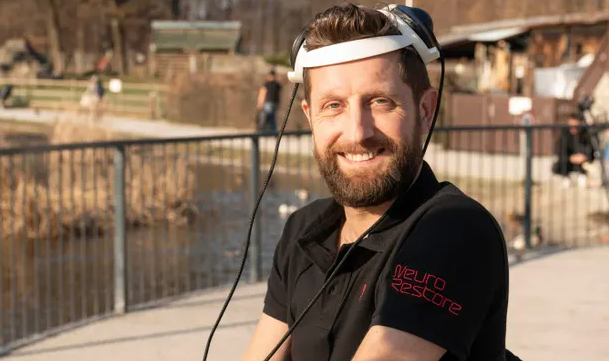
A paralyzed guy walks with a brain-spinal cord gadget. Thanks to a novel implant connecting his brain and spinal cord, a man crippled 12 years ago can now walk again at the thought of a footstep.
Gert-Jan Oskam, then 40 years old, suffered a cervical spinal cord injury in a bicycle accident 2011. This resulted in complete paralysis of his legs and partial paralysis of his arms.
But now, with the help of a “digital bridge” connecting his brain and the nerves below his injuries, he is back on his feet and walking using crutches.
Read more: Boris Johnson was referred to the police for possible violations of Covid rules.
Oskam commented, “Within five to ten minutes, I could control my hips like the brain implant picked up what I was doing with my hips.”
His brain sends a signal to electrodes on his spinal cord, stimulating his spine whenever he conceives of walking.
“I can now do whatever I want. Oskam explained, “As soon as I think about taking action, the stimulation will begin.” “This easy pleasure has made a huge difference in my life.”
Considering taking a stroll now.
Oskam participated in a trial in 2018 that demonstrated how technology that stimulates the spine with electrical impulses could assist persons with spinal cord injuries in walking again with intensive training. Still, his progress had plateaued after three years.
Two disc-shaped implants were implanted into his skull to rest on the brain’s membrane and the initial spinal implant, each containing 64 electrodes.
The skull implants now pick up on electrical activity in the cortex, the brain’s outermost layer, whenever Oskam even thinks about walking.
The part of the spinal cord that regulates movement must receive a signal from the brain for a person to walk. Professor Gregoire Courtine, a neuroscientist at EPFL, the Swiss Federal Institute of Technology in Lausanne, said, “When it’s a spinal cord injury, this communication is interrupted.”
“Our idea was to re-establish this communication with a digital bridge, an electronic communication between the brain and the region of the spinal cord that is still intact and can control the leg movement,” Courtine explained.
Oskam’s spinal pulse generator receives this signal via wireless transmission from a computer carried by the patient in a backpack.
After the equipment is in place, the patient and medical staff must train to interpret the patient’s brain impulses and translate them into commands for the spinal cord stimulator. However, that was a quick read. Professor Jocelyne Bloch, a neurosurgeon at EPFL, said, “In a few sessions, everything is linked, and the patient starts training.”
“Electronic servicing.”
Oskam regained voluntary movement of his legs and feet after undergoing roughly 40 therapy sessions using the brain-spine interface.
Training with the new device may have prompted an additional recovery in nerve cells that were not completely severed during Oskam’s injury, according to the team’s study published Wednesday in the journal Nature.
“What we observed along the duration of this training is a digital repair of the spinal cord,” stated Courtine.
He used the digital bridge to move his paralyzed muscle, which “suggested that this digital bridge also promoted the growth of new nerve connections” after years of paralysis.
He can even go a short distance with crutches without the aid now.
Three persons are needed for Courtine’s team to test if a similar device can restore arm movements.
